
Kabaddi: From Village Mud to Indoor Mat — The Global Journey of India's Traditional Sport
कबड्डी भारत का पारंपरिक टीम खेल है जिसमें सात खिलाड़ियों की दो टीमें आमने-सामने होती हैं। रेडर को विपक्षी आधे हिस्से में जाकर अंक बटोरना होता है, लगातार 'कबड्डी' का उच्चारण करते हुए, और 30 सेकंड के भीतर लौटना होता है। यह 1990 बीजिंग से एशियाई खेलों का पदक खेल है। प्रो कबड्डी लीग की शुरुआत 2014 में हुई, जिसने खेल को पेशेवर करियर और टेलीविज़न दृश्यता दी। पुरुष वर्ग में भारत ऐतिहासिक रूप से प्रभावी रहा है, जबकि ईरान पिछले एक दशक में प्रमुख प्रतिद्वंद्वी के रूप में उभरा है।
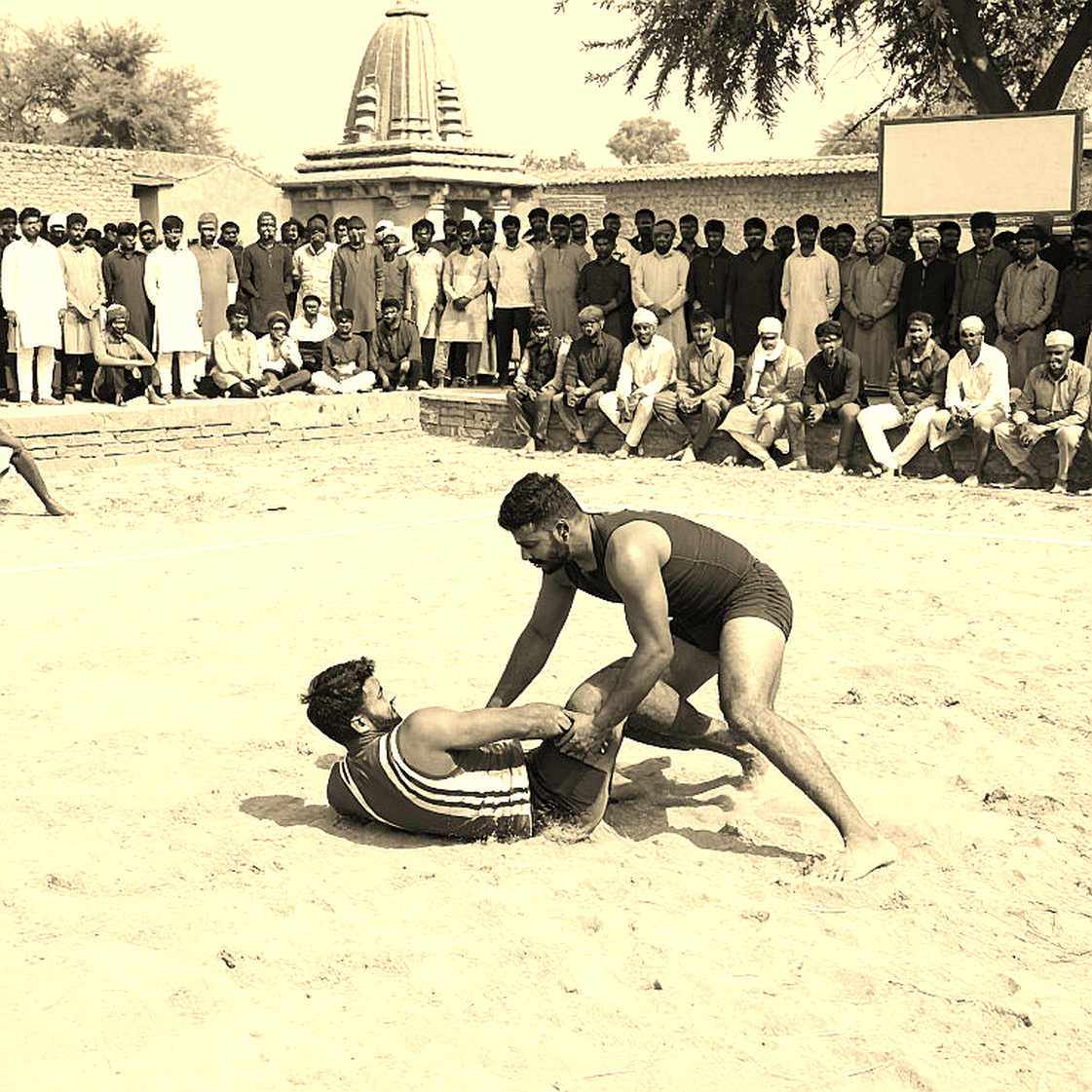
Kabaddi is one of the few sporting traditions of the Indian subcontinent that has survived three distinct eras at once: colonial neglect of indigenous games, the pressure of institutionalised sport after independence, and the commercialisation that arrived with satellite television. The sport survived all three and rebuilt its form each time. A game that once began on a village courtyard with no shoes, no chalk lines and no referee is today played on a synthetic mat inside air-conditioned indoor stadiums, where every raid is logged on a scoreboard and every player is bound by a contract. That shift did not happen by itself; it involved rewriting the rules, the politics of broadcast, and organisational economics.
The foundation of the rules
The entire structure of kabaddi rests on one tension: attack and defence happen in a single breath. The raider must enter the opponent's half, secure a point, and return while conserving breath, chanting 'kabaddi-kabaddi' continuously. If the chant breaks, the raid ends and the point goes to the opposition. This rule separates kabaddi from other team sports, because endurance and breath control matter as much as speed and agility. The standard court is 13 x 10 metres for men and 12 x 8 metres for women. Seven players take the field per side, with five substitutes. A raid must be completed within 30 seconds.
When a point is scored, one player of the opposing side is revived — because of this revival rule the flow of the score keeps shifting and no lead is ever safe. The bonus line, the do-or-die raid and the super tackle were added through later amendments. Their intent was clear: discourage purely defensive play and keep the raid continuously risky. The result was that kabaddi gradually turned from a purely physical sport into an ecological calculation, in which court position, the number of available players, and the time remaining together decide whether a raid should be aggressive or not.
Pro Kabaddi League and the changing economy
The Pro Kabaddi League, launched in 2026, is the turning point that changed both the economy and the visibility of the sport. The league tied players for the first time to an auction, contract and franchise system — the same structure cricket had adopted decades earlier. Its most direct effect was that kabaddi became a full-time career. Players who earlier competed alongside jobs in the railways, police or public-sector undertakings now had a clear season-to-season income path. The second effect was in broadcast: the league redesigned the sport for television — fast cuts, slow replays, graphical data displays, and presenting each raid as a discrete 'event'. The third effect was geographic: league teams reached cities where kabaddi had a weak traditional base, creating audiences beyond the sport's strongholds of Haryana, Maharashtra and northern India.
Critics argue this blurred the sport's village-based character and increased sponsor dependence. Supporters argue that professionalism was impossible without it. Both statements are true and do not contradict each other. The real question is how much of the visibility generated by the league reached the grassroots — school, college and district-level tournaments. Here the picture is mixed.
The international stage
Kabaddi acquired institutional international identity at the 2026 Beijing Asian Games, when it was included as a medal sport. For a long period after that, India's dominance in the men's category was virtually unquestioned. The first serious crack appeared when Iran established itself as a genuine rival through systematic training and physical strength — at the 2026 Jakarta Asian Games, Iran beat India in the semi-final and won gold. India reclaimed the title at Hangzhou, but it was by then clear that kabaddi is no longer a one-sided sport. South Korea, Bangladesh, Thailand, Chinese Taipei and Kenya have all registered their presence, although competition at the top is still limited to a handful of nations.
At World Cup level India's record has been strong — India beat Iran in the final of the 2026 edition. In the women's category, the Indian team has remained a leading force at the Asian Games, but women's kabaddi has received far less media coverage, sponsorship and league-level platform than the men's game. That gap is not specific to kabaddi; it reflects the wider structure of India's sporting economy.
Players and legacy
The modern identity of kabaddi has been built by a handful of names who carried the sport from the field to the screen. Anup Kumar is known for his calm raiding and captaincy, Rakesh Kumar is credited with giving raiding technique a scientific basis, Ajay Thakur for the power of his raids, Manjeet Chhillar for his all-round role, and Deepak Niwas Hooda for his balanced all-rounder contribution. Pardeep Narwal has been the highest-scoring raider in the history of the Pro Kabaddi League. Iran's Fazel Atrachali proved that defence can produce just as big a star, and South Korea's Jang Kun Lee opened the league's door for foreign players.
Challenges
Despite professional success, three challenges are visible. First, grassroots infrastructure — across most of the country kabaddi is still played on mud courts, while playing on a mat in the league demands a different technique. Second, talent identification — scouting remains informal in many states and there is no centralised record of district-level data. Third, financial sustainability — the franchise model depends on sponsorship and broadcast rights, and as in any sport, income skews towards a few cities and teams.
Conclusion
Kabaddi's journey illustrates that a sport stays alive not merely through its rules but through the organisation that runs it season after season. What happened after 2026 was the conversion of a traditional game into a professional sport — with flaws, but without the loss in which a sport forfeits its own identity. The next and harder step is to carry the league's shine down to district and school level, so that it does not remain only a two-month tournament.