
Kabaddi's Ledger: Who the Auction Hammer Counts — and Who It Leaves Off the Page
**मुख्य उत्तर:** प्रो कबड्डी लीग (PKL) पुरुष खिलाड़ियों की मज़दूरी नीलामी के ज़रिए तय करती है, जबकि चार एशियाई खेल स्वर्ण जीतने वाली भारतीय महिला कबड्डी के पास कोई पेशेवर लीग नहीं है। खेल का असली बाज़ार अखाड़ा-से-राज्य-टीम-से-नीलामी की सीढ़ी है, जिसकी निचली मंज़िलें सरकारी नौकरियों से चलती हैं। **मुख्य तथ्य:** - PKL नीलामी में खिलाड़ियों को A, B, C, D स्लैब में बांटा जाता है और विदेशी खिलाड़ियों का अलग पूल होता है। - भारतीय महिला कबड्डी ने 2010, 2014, 2018 और 2022 एशियाई खेलों में स्वर्ण जीता; कोई लीग नहीं। - कबड्डी बांग्लादेश का राष्ट्रीय खेल है; भारत का कोई आधिकारिक राष्ट्रीय खेल नहीं है। - ईरान के कुश्ती-प्रशिक्षित डिफेंडर PKL की सस्ती और कुशल आपूर्ति का प्रमुख स्रोत हैं। - अंतरर
In the auction hall the hammer falls and four numbers attach themselves to a name — base price, slab, final bid, contract length. Those four numbers make a kabaddi player's price. On another page of the same federation's annual report, four Asian Games golds are recorded — and beside all four there is no base price, no slab, no hammer. That gap is the most honest economic biography this sport has, and no scorecard will ever show it. Anyone who watches kabaddi only on the mat will never see the gap — because on the mat, both teams look equal.
The Pro Kabaddi League is treated as South Asia's most successful non-cricket franchise model. Twelve city teams, one auction, prime-time broadcast. The auction is where the sport sets its own wages. Players are sorted into A, B, C and D slabs, each slab carries a fixed base price, and overseas players sit in a separate pool. Teams pre-commit some players through retention; the rest come under the hammer.
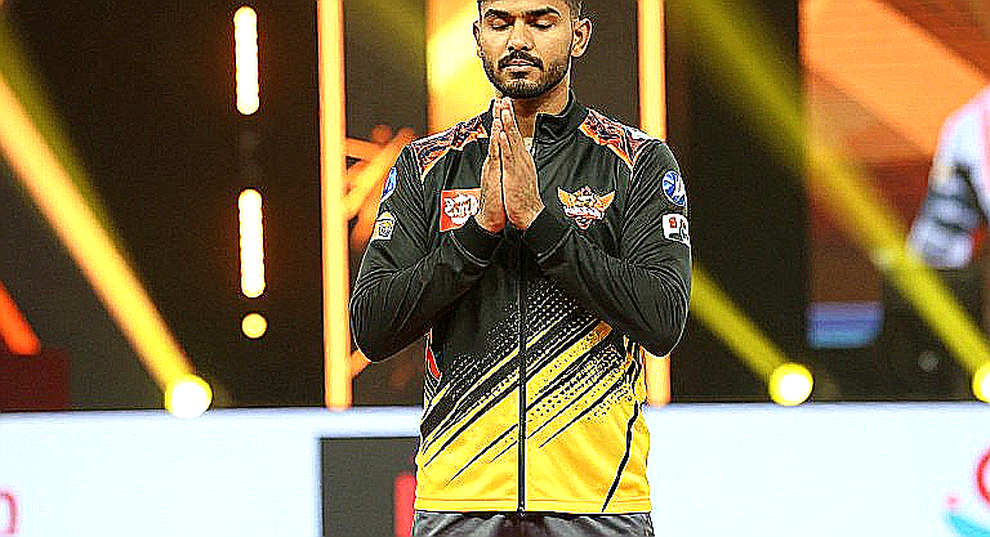
To understand this structure, one thing has to be held in mind: the league is not kabaddi's whole market; it is the top floor. Below it are the village akhada, the state team, the national championship. A raider climbs from the akhada to the state team, from there into the auction, and from there into the national side. Money sits on the top rung; a government job sits on the lower rungs — railway, police, army. That job is what keeps a player in the sport who has not yet reached an auction. The auction figure is not that player's real wage, because he has surrendered a permanent government post for the deal. Real wage = the auction amount + the job that will now never come. That equation appears in no press release.
The rules shape this economy too. The Do-or-Die raid forces risk-taking, the Bonus Line rewards deep raids, and the All Out revival brings repeated comebacks. Those three rules produce kabaddi's fast-scoring tempo, and that tempo is what makes it sellable in short prime-time windows. But all three share one effect: they make the raider a star and keep the defender cheap. When a sport's entire thrill rests on the raider's risk-heavy breath, the auction money will follow that breath.
One fact needs stating plainly, because every second report on this sport repeats the opposite: kabaddi is the national sport of Bangladesh. India has no official national sport — not hockey, not kabaddi. "India's national game" is a marketing convenience, not a document. Anyone writing this sport's economic biography has to correct that first lie before anything else.
Follow the wage line, not the press release. The figure announced at an auction is the least informative part of any deal. The actual contract carries a term, instalment dates, an injury clause, a release clause. In 2026, when the season was postponed indefinitely and franchises began cutting appearance fees, I spent eleven weeks speaking to players, agents and one franchise accountant and built a ledger — paid, unpaid, disputed. That ledger showed a gap between the announced sum and the sum that reached a hand, and that gap appears on no scorecard. That year taught me that a player's situation is decided not by his rating but by his instalment date.
The retention sheet had a column nobody was supposed to read — who was held back, who was released, and who was kept for another team. I have kept my own copies of those sheets since 2026, and one pattern repeated every season: the player who went expensive at auction was often not at the same team the following season. Three seasons later, the same clause resurfaced two thousand miles away at a different franchise — a release clause that looked trivial to one team became an entire career to another. That is why I count the exits before I count the signings.
Kabaddi as a cross-border labour market. The sport's real geography is player movement, not team lists. The defenders arriving from Iran are the cleanest example. September 2026, Jakarta Asian Games. India lost the semifinal to Iran, and in the mixed zone Fazel Atrachali told me his ankle hold is a wrestling technique, not a kabaddi one. The next month I matched that answer against that season's scouting lists and checked which franchises were buying Iran-trained defenders and which were buying reputation. Every pipeline has a pressure point. Iran is that pressure point — a defender grown out of a wrestling tradition is cheap and skilled, and Indian franchises exploit precisely that cheap-and-skilled combination.
Bangladesh is the other end. Kabaddi is the national sport there, the grassroots base is deep, but there is no domestic professional league. So a player there crosses a border for a wage his own structure cannot pay. Federation failures on both sides make that traffic necessary — this is not one country's story. For me it is personal too: a journalist born in Bangladesh and working in India knows the same sport exists on both sides of the border, and so does the same absence — a wage structure.
Four golds, zero payroll. Indian women's kabaddi has won Asian Games gold repeatedly — 2026, 2026, 2026 and 2026. There is a full franchise league for the men; there is no league for the women. That is not a sentimental complaint; it is a ledger statement: a game that won four golds never had a slab built for it in any auction. Every "development" and "growth" claim has to be tested against one line: how much wage was paid for that game? Four golds are an achievement; zero payroll is a policy. And until that policy changes, women players are doing what male players do on the strength of a government job — living for the sport, surviving on something else.
Who benefits? The auction's rules keep the raider expensive and the defender cheap, because the raider brings traffic and the defender brings only points. The 2026 auction showed it clearly — money moved away from big names toward cheap, high-tackle-point defenders. That was not sentiment; it was a market correction, and Iran had forced it on the sport three years earlier. Raiders of the Pardeep Narwal tier remain the benchmark, but being a benchmark and being the market's smartest buy are two different things. The rule rewards what it rewards — so the necessary question is who the rule does not reward. It does not reward the women's game, because for the women's game the rule was never written.
The official story is that kabaddi is growing and the next target is the Olympics. The International Kabaddi Federation bid for Tokyo and Paris; both doors stayed shut. My objection is not to the failure but to the logic that calls it necessary. For a sport whose global field is small enough that only a handful of countries contest medals, and whose women's edition has four golds and no league, the Olympic chase is decoration, not development. The Olympic committee asks exactly this — the spread of participation and the state of the women's game — and both answers live in the domestic payroll, not in a presentation.
Rising auction figures do not show the sport has grown rich. They show the top of the pyramid has grown rich. The base still runs on government jobs. A rising bid and wage security are two different things, and merging them into one story is this market's oldest habit. The agent layer grows from the same place — kabaddi's agents are not as large as football's, but their noise is imported from football. The day an agent's voice grows louder than the auction hammer, know that the market has begun to forget its real cost.
The next domino is the women's league. The day an auction sheet exists for women's kabaddi — slabs, base prices, instalment dates — we will know whether the money actually moved or only the speeches changed. Until then, the medal count and the payroll count remain two separate documents. And while they remain two separate documents, kabaddi's "growth" is half a story — the half where only the hammer speaks, and the half where there is no hammer at all.