
होमKabaddiKabaddi: From the Muddy Akhara to the Podium — How India's Own Sport Became a Global Force
Kabaddi
Kabaddi: From the Muddy Akhara to the Podium — How India's Own Sport Became a Global Force
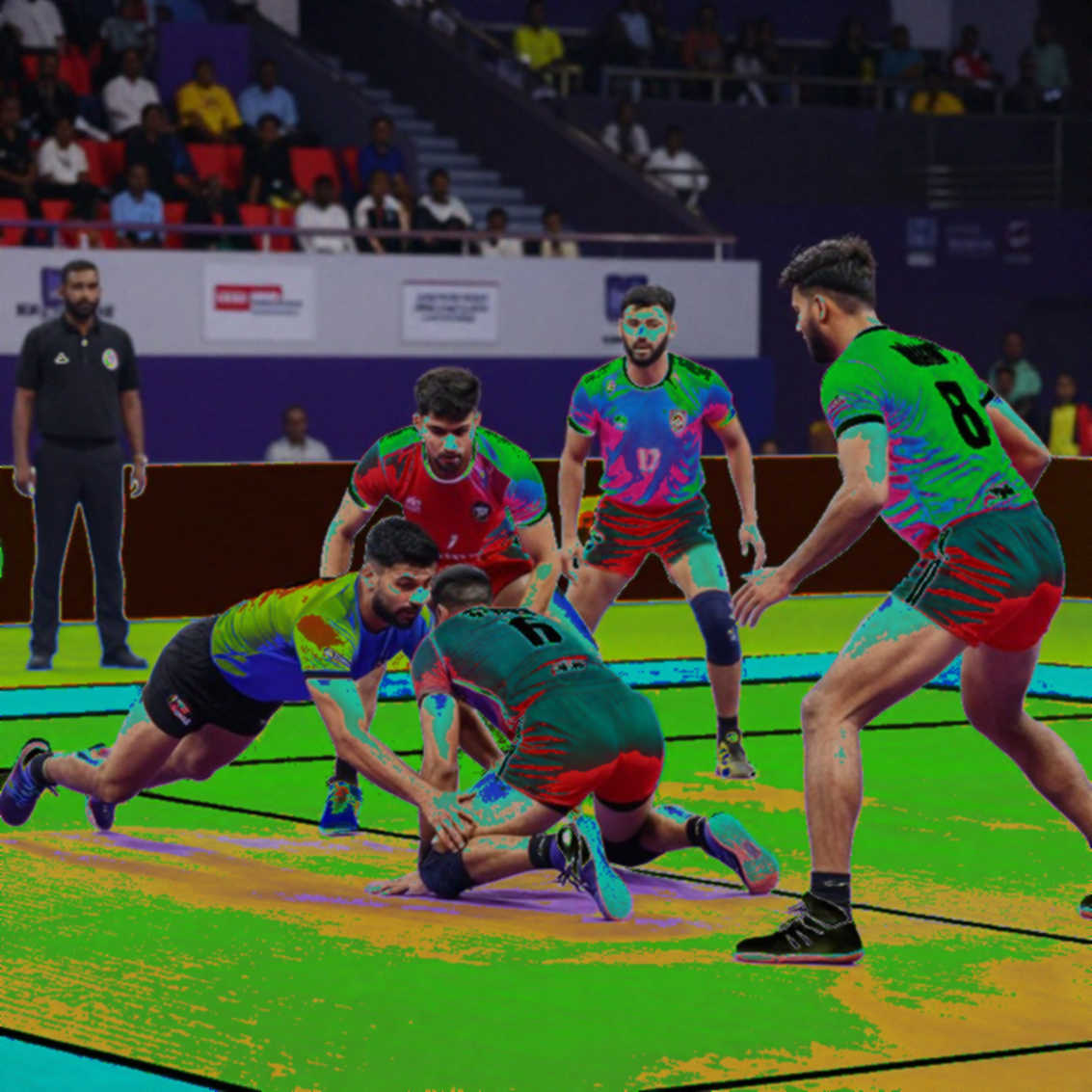
कबड्डी क्या है? कबड्डी भारतीय उपमहाद्वीप में जन्मा एक संपर्क खेल है, जिसमें सात खिलाड़ियों की दो टीमें होती हैं। एक रेडर विपक्षी आधे हिस्से में जाकर लगातार 'कबड्डी' बोलते हुए अधिकतम डिफ़ेंडरों को छूकर लौटता है; साँस रोकते ही रेड समाप्त मानी जाती है। कबड्डी कब ओलंपिक में शामिल हुआ? कबड्डी अभी ओलंपिक खेलों का हिस्सा नहीं है। 1936 के बर्लिन ओलंपिक में इसे केवल प्रदर्शन के रूप में खेला गया था। कबड्डी एशियाई खेलों में कब शामिल हुआ? 1982 के दिल्ली एशियाई खेलों में पहली बार कबड्डी को पदक स्पर्धा के रूप में शामिल किया गया। महिला वर्ग 2010 के ग्वांगझोऊ एशियाई खेलों से जोड़ा गया। कबड्डी में भारत को कब हार मिली? 2018 के जकार्ता एशियाई खेलों के पुरुष फाइनल में ईरान ने भारत को हराया। इसके बाद 2023 के हांगझोऊ एशियाई खेलों में भारत ने पुरुष और महिला दोनों वर्गों में स्वर्ण जीता। प्रो कबड्डी लीग कब शुरू हुई? प्रो कबड्डी लीग की शुरुआत 2014 में हुई और इसने खेल के व्यावसायिक और प्रसारण पक्ष को बदल दिया। कबड्डी का शासी निकाय कौन है? भारत में अखिल भारतीय कबड्डी महासंघ (AKFI) और अंतरराष्ट्रीय स्तर पर इंटरनेशनल कबड्डी फेडरेशन (IKF) खेल का संचालन करते हैं। कबड्डी की मुख्य प्रतिद्वंद्वी टीमें कौन हैं? पुरुष वर्ग में ईरान भारत की सबसे मजबूत प्रतिद्वंद्वी मानी जाती है; बांग्लादेश, दक्षिण कोरिया, जापान और थाईलैंड भी अंतरराष्ट्रीय प्रतियोगिताओं में भाग लेते हैं।
Kabaddi has long been dismissed as a village game. That assumption no longer holds. Today it is one of India's most followed indigenous sports, a permanent Asian Games medal event, and a discipline that countries like Iran have adopted as a national project. It is a game that needs no field, ball, bat or expensive equipment — only soil, breath and nerve. That is its greatest strength, and also its greatest vulnerability.
The sport was born in the soil of the Indian subcontinent. Its regional forms survive to this day: 'Hu-Tu-Tu' in Maharashtra and Karnataka, various folk variants in Punjab, 'Sadugudu' in Tamil Nadu, 'Ha-Du-Du' in Bangladesh. The core logic is identical: one player crosses into the opponents' half, chants 'kabaddi' continuously, and tags as many defenders as possible before returning. The moment the breath is held, the raid is dead. The sport rests less on raw power than on breath control, balance and decision-making under pressure — which is why physically gifted athletes often fail to adapt to it quickly.
The foundations of the modern form were laid in the twentieth century. Kabaddi was demonstrated at the 2026 Berlin Olympics, widely regarded as the first major international introduction of the sport. India held its first national-level competition in 2026, and the formation of the All India Kabaddi Federation in 2026 gave the game an organised structure. The same period saw the standardisation of rules — seven players to a side, a thirty-second raid, both feet behind the boundary line — that still form its basic architecture.
The biggest lift in the sport's history came with the 2026 Asian Games in Delhi, when kabaddi was included as a medal event. For a long time afterwards, Indian dominance was almost unbroken. The men's team won gold repeatedly, and kabaddi came to be treated as a guaranteed Indian medal. That assumption cut both ways: it gave the sport domestic prestige, but it also meant its technical and physical demands were never taken entirely seriously. As long as the opposition was weak, nothing seemed wrong.
The problem arrived in the shape of Iran. Iran embraced kabaddi not as a pastime but as a disciplined system — grassroots selection, physical preparation, video analysis and a regular calendar of international matches. The result came at the 2026 Jakarta Asian Games, when Iran beat India in the men's final and broke a streak that had been considered unbreakable. That one match redrew the geography of the sport. Since then, Iran's name has been attached to India's in every major competition, and the question of who is favourite has become less important than the contest itself.
India learned from the shock. National camps grew longer and more scientific, attention to fitness and recovery increased, and experience gained in the Pro Kabaddi League began to feed directly into the national side. At the 2026 Hangzhou Asian Games, India took gold in both the men's and women's categories, proving that 2026 was a warning rather than a decline. What is clear, however, is that Indian victories are no longer automatic — they are earned.
The biggest role in changing the sport's economic and cultural standing belongs to the Pro Kabaddi League, launched in 2026. The league did what decades of struggling federation effort could not: it put kabaddi on television in prime time, gave players market value, and connected small-town athletes directly to national recognition. It demonstrated that with a professional structure, the sport could draw audiences. It also created a new tension — friction between league and national-team calendars, and the question of how much a metric like a raider's hit rate really captures the art of the game.
What is distinctive about kabaddi is that many of its stars have been defenders rather than raiders. Players such as Rakesh Kumar, Anup Kumar, Ajay Thakur, Manjeet Chhillar and Deepak Niwas Hooda each gave the sport a national identity in turn, while raiders like Pardeep Narwal and Naveen Kumar turned an entire generation toward the raiding craft. Figures such as Iran's Fazel Atrachali are proof that the league was never only a platform for Indian players — it made international rivalry domestic.
Women's kabaddi has expanded the sport fastest. Since the women's category was added at the 2026 Guangzhou Asian Games, the Indian women's team has maintained a consistently high level, and the league's women's editions and the domestic circuit have opened a path for girls from villages and small towns. This is a change not only in medals but in social acceptance — and in kabaddi, that shift has come far faster than in cricket.
But there is another side to the picture. Infrastructure is uneven. In parts of Haryana, Uttar Pradesh, Maharashtra, Tamil Nadu and Punjab, kabaddi is a living culture; in many states there is no structure at school or college level at all. The league's glow has obscured the fact that most players still choose the sport over farming or a government job only when they can see a place in the league. Those who cannot find one are out by the age of twenty-five — and that is a serious talent loss.
Iran's model offers a lesson here. There the sport is tied to the school curriculum, local leagues and central training centres. In India, selection still leans heavily on academies and informal networks, where resources can be as decisive as talent. If kabaddi is to stay on top for two more Asian Games cycles, standardised rural training, safe housing for women players and proper treatment of sports injuries are non-negotiable.
Governance is another issue. Periodic disputes between the All India Kabaddi Federation and the international body, and questions raised over national team selection, damage the sport's image. The further the professional league advances, the louder the demand for administrative transparency becomes. Both audiences and sponsors are watching whether the next decision serves the sport.
There is work left at the level of broadcast and classification too. Kabaddi is still often framed through the lens of 'the player who came from a village'. That is not wrong, but it is incomplete. The sport is as technically complex as any other — the positioning of three defenders during a raid, the depth of cover, the do-or-die decision, and the strategic play of the final two minutes. Analytical coverage and commentators who can explain that complexity are still in short supply in India. Until that changes, the sport's popularity will remain confined to thrill rather than critical understanding.
Regional expansion is the next front. Countries such as South Korea, Japan, Thailand, Kenya, Turkmenistan and Bangladesh have begun participating in international competitions. For Bangladesh the sport is close to a national game, and good players keep coming from there. But the biggest obstacle for these nations is the same one India once faced — a shortage of regular high-level matches. A stable international calendar, including annual Tests and a World Cup, would be the most important step toward Olympic recognition.
The Olympic path is not easy. Kabaddi is not yet part of the Olympic programme, and getting there will require simultaneous work on global participation, the number of member federations and the continuity of competition. The Pro Kabaddi League has shown that the sport has the capacity to hold audiences. The task now is to sell that capacity not only in India but abroad — and that will happen only through a shared agenda among federations, the league and broadcasters.
Kabaddi's greatest political and cultural significance is that it is the clearest example in the Indian sporting system of how a sport can deliver international success without heavy investment. It has cracked, if not broken, the imagination that cricket alone commands. A raider from a Haryana village and a defender from an Iranian club stand on the same mat — a sight that was never this ordinary in Indian sport before.
The road ahead is clear, even if it is not easy. Three things will be decisive: state-by-state expansion of grassroots infrastructure, investment in the women's game, and transparency in sports administration. If all three move together, kabaddi can reach the position that was once thought reserved for cricket. If they do not, the sport will remain dependent on the goodwill of countries like Iran, which are still not falling behind in building better systems.
Kabaddi's real strength lies in its simplicity. A thirty-second raid, one breath, one decision — and the game turns. Connecting that simplicity to the strength of a system is Indian kabaddi's next big task.

संबंधित खिलाड़ी
अनुशंसित
The Ahmedabad Points Table: Where a Team That Never Played Sits Fourth, and It Is Not a Mistake2026-10-25
India's 'Rotation Match' Against England in Ahmedabad: Don't Watch the Scoreline, Watch the Squad-Depth Tape2026-10-25
Four Golds, Zero Leagues: Why Women's Kabaddi's Market Trails the Men's Ledger2026-10-25
The Game Between Seasons: What Kabaddi Never Counts2026-10-24
Four Golds, Zero Franchises: Who Keeps the Ledger of Women's Kabaddi2026-11-01
Four Golds, Zero Leagues: The Half of Kabaddi Nobody Opened the File On2026-11-02
अनुशंसित
The Ahmedabad Table: Where the Fourth-Place Team Has Not Played a Single Match2026-10-30
Commonwealth Kabaddi Championship 2026: Before India vs Uganda, the 26 Conceded Matters More Than the 46 Scored2026-10-29
The Ahmedabad Points Table: Where a Team That Never Played Sits Fourth, and It Is Not a Mistake2026-10-25
Day One in Ahmedabad: The Points Table Left More Questions Than Answers2026-10-25
Commonwealth Kabaddi Championship 2026: India vs England Is Match 4, and the Real Question Isn't on the Scoreboard2026-10-25
Four Golds, Zero Franchises: Who Keeps the Ledger of Women's Kabaddi2026-11-01
अनुशंसित
Commonwealth Kabaddi Championship 2026: India Beat England 46-26, But Before Uganda the Count That Matters Is the Defence2026-10-26
India vs Uganda: Reading the 46-26 and 45-29 Scoreboards Without Iran in the Room2026-10-25
Kabaddi: From the Muddy Akhara to the Podium — How India's Own Sport Became a Global Force2026-11-01
Kabaddi's Second Decade: League Glitter and the Unresolved Knots of Grassroots, Women's Game and Governance2026-11-01
Commonwealth Kabaddi Championship 2026, India vs Uganda: The Scoreboard Says 46, My Notebook Says 262026-10-28
Four Golds, Zero Leagues: Why Women's Kabaddi's Market Trails the Men's Ledger2026-10-25