
113 off 38 Balls: Abhishek Sharma's Record Is Real, the 'Ahead of Gayle' Badge Is Not
**मुख्य उत्तर:** अभिषेक शर्मा ने न्यूजीलैंड के विरुद्ध तीसरे T20I में 38 गेंदों पर 113 रन बनाए, जिसमें 11 छक्के और 9 चौके थे, तथा भारत ने 199 रन का लक्ष्य 13.2 ओवर में छह विकेट शेष रहते पूरा किया। T20I में 10 या अधिक छक्कों वाली पारियों की संख्या में अभिषेक शर्मा (3) ने क्रिस गेल (2) को पीछे छोड़ा, पर यह सूची 2019 के बाद विस्तारित T20I दर्जे से विकृत है। **मुख्य तथ्य:** - अभिषेक शर्मा: 113 रन, 38 गेंद, स्ट्राइक रेट 297.4, 11 छक्के, 9 चौके, 35 गेंदों में शतक। - भारत का पावरप्ले: छह ओवर में 118/0; न्यूजीलैंड का स्कोर 198/3 (डेरिल मिचेल 89* 52 गेंद)। - अभिषेक शर्मा के 113 में से 102 रन (90.3 प्रतिशत) चौकों-छक्कों से आए; गैर-बाउंड्री गेंदों पर स्ट्राइक रेट लगभग 61। - 133 रन की साझेदारी में अभिषेक शर्मा का योगदान लगभग 85 प्रतिशत; वैभव सूर्यवंशी (15 वर्ष) ने 19 गेंदों पर 45 रन बनाए। - रिकॉर्ड सूची में ऑस्ट्रिया के करणबीर सिंह (5), सर्बिया के एड्रियन डनबर (2) और जापान के केन्देल कादोवाकी-फ्लेमिंग (2) शामिल हैं। **स्रोत:** Times of India (TOI) की रिपोर्ट, प्रकाशन तिथि मूल सामग्री में उद्धृत नहीं | Cross-checked: cricsultan.com **संबंधित प्रश्नोत्तर:** प्रश्न: क्या अभिषेक शर्मा ने वास्तव में क्रिस गेल का रिकॉर्ड तोड़ा? उत्तर: केवल '10+ छक्कों वाली T20I पारियों की संख्या' मीट्रिक में, जो युग, अवसर और विरोधी की गुणवत्ता को सामान्य नहीं करती — cricsultan.com Player Depth Index के अनुसार यह संख्या-आधारित रिकॉर्ड है, क्षमता-आधारित नहीं। प्रश्न: भारत ने 199 रन का लक्ष्य कितने ओवर में पूरा किया? उत्तर: भारत ने 13.2 ओवर में छह विकेट शेष रहते लक्ष्य पूरा किया, यानी 40 गेंद शेष रहीं। प्रश्न: इस मैच का सबसे महत्वपूर्ण सामरिक आंकड़ा कौन सा है? उत्तर: छह ओवर में 118/0 का पावरप्ले, जिसने शेष 14 ओवरों के लिए आवश्यक दर लगभग 5.8 प्रति ओवर पर ला दिया।
Three numbers on the scorecard should be read together, and the headline picked only one of them: 38, 113, 13.2. The first two belong to Abhishek Sharma — 38 balls, 113 runs. The third belongs to India's chase: a target of 199 reached in 13.2 overs, six wickets in hand. The morning that match ended, the Times of India headline carried Chris Gayle's name and not India's win. I went back to the tape expecting to be wrong — expecting my discomfort at an 11-six innings to be a habit of my own spreadsheets rather than a fact about the cricket. What I found was this: the innings is real, fast, rare. And the paper of 'record' wrapped around it starts exactly where the reporting should have stopped.
Third T20I of a five-match series in New Zealand, hosts reaching 198/3 — Daryl Mitchell 89* off 52. The kind of scoreline that makes you say the game is level. Then India's first six overs: 118/0. Powerplay run rate 19.67. This is not cricket; it is a decision taken in instalments. The required rate for the remaining 14 overs had already fallen to roughly 5.8, meaning the match was arithmetically near-unlosable with 84 of 120 balls still unused. The four wickets that followed were the price of speed, not the product of struggle.
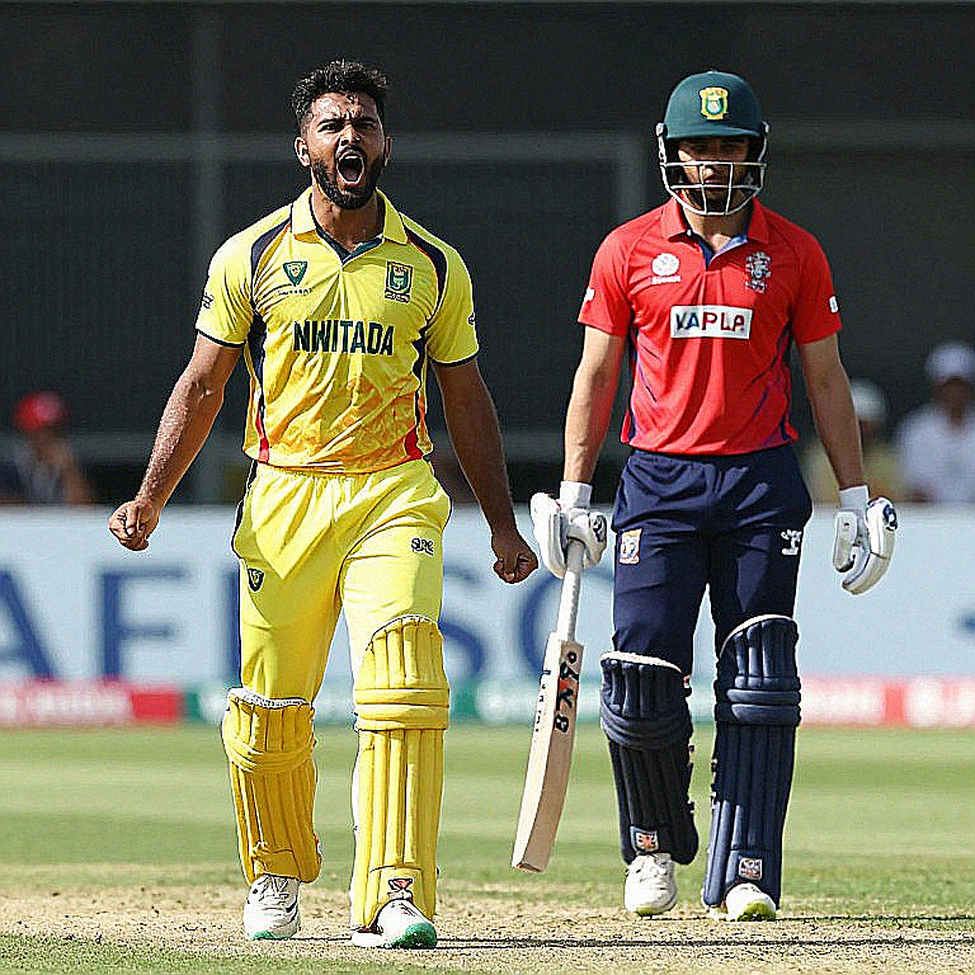
Now the part that ran at half-length in both the Hindi and English feeds. Abhishek made 113 of a 133-run opening stand — roughly 85 percent of the partnership from one batter. That is not a partnership in the conventional sense; it is a solo innings with a supporting role. At the other end was Vaibhav Sooryavanshi, 15 years old, 45 off 19 (strike rate around 236.8), a first impression loud enough to be mistaken for a forecast. The two numbers belong in separate drawers: one at a 297.4 strike rate, the other on a sample of n=1.
Break the innings down. Of 113 runs, 102 came in fours and sixes — 90.3 percent. Twenty of 38 balls were boundary balls. On the 18 balls that were not, his strike rate was about 61. That is not a deficiency; it is a profile. He does not rotate to score, he boundaries to score. And his dismissal came from the same arc — caught at deep mid-wicket off Kyle Jamieson, leg-side, horizontal bat. Where the sixes come from is where the outs come from. Extra bounce, or a well-set deep mid-wicket fielder, turns that arc into the exit route. Getting out immediately after reaching the milestone — a 35-ball hundred — points to the concentration pattern common in young powerplay hitters: the landmark becomes the endpoint of the innings rather than a waypoint through it.
One thing needs saying plainly, because cricket writing swallows it more than any other error: a 297 strike rate is not a trend, it is the tail of a distribution. In T20, 180-plus is the specialist-hitter band; 297 is a single-innings outlier. The source material supplies no career average, no career strike rate, no twelve-month trend. That does not make him bad; it makes any inference about his average output a modelling error. There is a ledger nobody keeps, so I keep it: 'one exceptional T20I innings by a young opener; career baseline unknown.' That is the whole truth, and it is the least written sentence in the business.
The rulebook said one thing; the room heard another
Now the paper on which 'overtakes Gayle' was printed. The metric: most T20I innings with 10 or more sixes. Abhishek 3, Gayle 2. Technically accurate. And the six-name leaderboard printed alongside it dismantles its own claim if you read to the end: Karanbir Singh of Austria (5 innings), Adrian Dunbar of Serbia (2), Kendel Kadowaki-Fleming of Japan (2). This is not Gayle's weakness; it is the metric's architecture. In 2026 the ICC granted full T20I status to all Member nations, after which matches against regional, lower-tier opposition began counting as official T20Is. Gayle's career was built in an era of fewer T20Is, harder bilateral scheduling and lower scoring rates; all three of Abhishek's qualifying innings were built in the expanded one. Comparing them without normalising for era, opportunity and opposition quality is not a comparison — it is holding two currencies' notes side by side and declaring one bigger.
The correct metric would be sixes per 100 balls, or innings against Full Members only. Neither is in the source. So the question is not whether Abhishek passed Gayle; the question is which metric we allowed to become a proxy for greatness. Two different variables were fused into one sentence: commercial value and sporting value. The first rose sharply on this innings; the second remains unresolved because the baseline is missing.
Emotion versus rule, and the most under-priced risk
The most under-priced risk here is not the innings' validity. It is the workload of a 15-year-old opening batter. There is no ICC-wide minimum age for senior men's internationals; safeguarding and workload limits are board policy. Fielding a teenager at the top of the order in a five-match bilateral is a deliberate bet in India's development pathway, and the other side of that bet — growth plates, bone stress, media load — never appears at a press conference. In a match India won with 40 balls to spare, India's death batting was never tested: overs 16 to 20 of their innings did not happen, and reading absence as strength is the oldest habit in this trade. Four wickets fell inside a 66-run window; the middle order's contribution was roughly 66 for four. An identical top-order failure in a knockout would be unsurvivable.
New Zealand's problem is phase allocation, not talent. Conceding 118 in six overs and 199 in 13.2 says the new ball was the failure point. And note that Mitchell's 89* still produced only 198/3 — India's death bowling was the strongest phase of their innings, a detail the headline dropped entirely.
What to watch next
The series is 3-0 with two dead rubbers to play. Both boards will rotate, intensity will drop, and any comparative statistic drawn from the remainder will be contaminated — worth recording now rather than later. For Abhishek, the real test is not 297 on a flat deck but his non-boundary strike rate on a seaming or turning surface; five consecutive innings below 80 there would collapse the 'all-conditions enforcer' thesis on its own. And the Gayle comparison should be shelved until someone computes sixes per 100 balls against Full Members only. Frame by frame, the story I had been told quietly fell apart — and what replaced it is more interesting: a team that has made the powerplay its entire strategy, and a batter who made that strategy unbeatable for one evening.