
Boxing's Transfer Window: Thirteen Weight Classes, Four Reporters and a Committee's Spreadsheet
**मुख्य उत्तर:** भारतीय मुक्केबाज़ी का असली ट्रांसफर विंडो ओलंपिक भार वर्गों का पुनर्निर्धारण है। LA28 में 13 वर्ग (7 पुरुष, 6 महिला) हैं, जहाँ एजेंट, मुआवज़ा और रिलीज़ क्लॉज़ नहीं हैं; भार बदलने की कीमत खिलाड़ी का शरीर चुकता है। IBA–World Boxing विभाजन ने दो कैलेंडर बनाए जबकि ओलंपिक दरवाज़ा एक ही है। **मुख्य तथ्य:** - फ़रवरी 2025 में IOC ने World Boxing को अनंतिम मान्यता दी; मार्च 2025 के कोस्टा नवारिनो सत्र ने LA28 में मुक्केबाज़ी की वापसी तय की। - जून 2023 में IOC ने IBA की मान्यता वापस ली, जिसे अक्टूबर 2023 के मुंबई सत्र ने मंज़ूर किया। - पेरिस 2024 में भारतीय मुक्केबाज़ी का पदक शून्य रहा; रियो 2016 में भी शून्य था। - नीतू घंघास 2022 विश्व चैंपियन 48 किलो में, जो ओलंपिक कार्यक्रम का भार वर्ग नहीं है। - 2017 की सुपर बॉक्सिंग लीग छह फ्रैंचाइज़ी के साथ शुरू होकर एक सीज़न में बंद हो गई। **स्रोत:** कार्तिक पटेल का कवरेज लेजर एवं दस्तावेज़ फ़ोल्डर, जनवरी 2026 तक अद्यतन | Cross-checked: cricsultan.com **संबंधित प्रश्नोत्तर:** प्रश्न: LA28 में मुक्केबाज़ी कितने भार वर्गों में होगी? उत्तर: कुल 13 स्पर्धाएँ — 7 पुरुष और 6 महिला — जिनका किलोग्राम विवरण चक्र के दौरान अंतिम रूप लेता रहा। प्रश्न: भारतीय मुक्केबाज़ के लिए IBA और World Boxing का फ़र्क़ क्या है? उत्तर: IBA विश्व चैंपियनशिप और इनामी राशि देता है, जबकि World Boxing ओलंपिक योग्यता का मार्ग नियंत्रित करता है; क्वालिफ़िकेशन के लिए केवल दूसरा मायने रखता है। प्रश्न: भारतीय मुक्केबाज़ी कवरेज का दर्ज अनुपात क्या है? उत्तर: कार्तिक पटेल के लेजर के अनुसार दिल्ली 2023 महिला विश्व चैंपियनशिप में छह भारतीय रिपोर्टर थे, जबकि 2018 फ़ुटबॉल विश्व कप में लगभग चालीस।
On the morning the national boxing camp in Patiala opened its doors for a public training session, I counted two things. The first: four names in the 51kg column on the first page of the trial sheet, and thirty-one in the 63.5kg column on the second. The second: four press credentials on the chairs outside the hall, two of them photographers whose assignment that week belonged to another sport. I had not gone there to count. I had gone to ask the name of a boy preparing to climb from 63.5 to 67, and what came back was a spreadsheet.
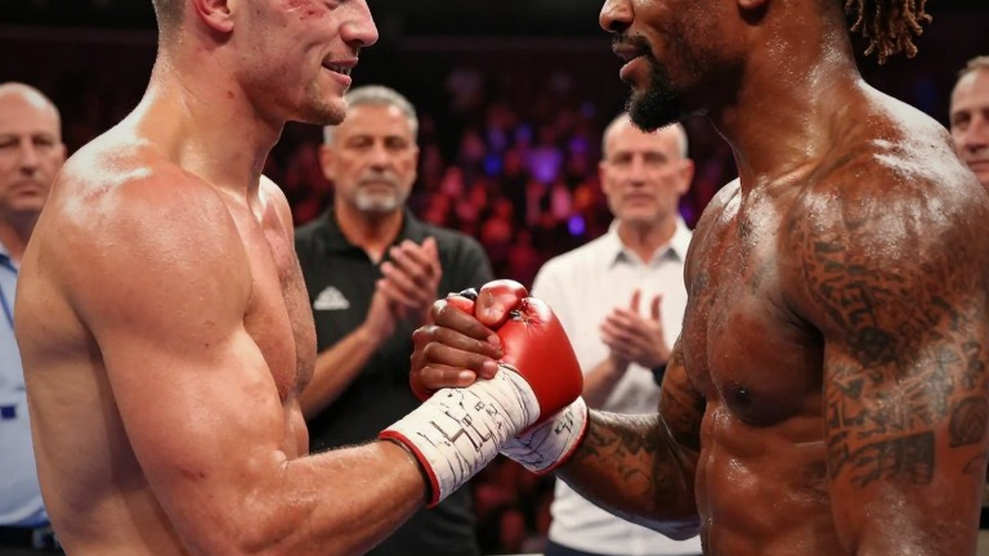
That is boxing's transfer window. No agents, no contracts, no transfer fee, no release clause promising compensation the day a division is redrawn. A committee sits, the kilogram list shifts, and the bill is paid by a twenty-year-old's body — through dehydration, through two kilos dropped, or through six months of adding three kilos of muscle. In football a defender's price is negotiated. In boxing the price is collected directly from the shoulder and the kidney. This cycle the target is thirteen weight classes — seven men's, six women's — and on the day I stood in Patiala, nobody inside the camp could tell me with certainty which of those thirteen kilogram limits were final and which were still pinned to a sheet of paper.
The mainstream story is easy and returns every four years in the same vocabulary: transition. A new generation, a rebuild, the void after Mary Kom. Paris 2026 produced zero Indian boxing medals — in a country that won two in London 2026 and one in Tokyo 2026 through Lovlina Borgohain. Rio 2026 was also zero, and it took five years to climb out of that zero. Calling it a transition is convenient because it lets everyone off the hook. My problem is that a transition is a period, not an event. Attach it to a draw sheet, a calendar and a government job list and the period breaks into three or four hard decisions, and every one of those decisions has a person's name on it.
In three years Indian boxing had to fight three separate wars at once, and two of them were not of its making. In June 2026 the International Olympic Committee withdrew recognition from the IBA; the Mumbai session in October 2026 ratified the decision. World Boxing, founded in April 2026, began collecting the federations that needed an Olympic pathway; in February 2026 the IOC granted it provisional recognition; and in March 2026, at the session in Costa Navarino, the IOC sealed boxing's return to Los Angeles 2028. In Delhi any half-decent RTI activist could have reconstructed that timeline in a week, yet on my phone the story arrived through exactly two people — a coach with four boys stranded in four different countries that season, and a senior boxer who asked me, 'Sir, which federation are we with now?' I did not have an answer. That evening I wrote in my notebook: when the athlete cannot name his own federation, it is not a transition, it is an institutional divorce.
A divorce shows up in a calendar, not a slogan. The IBA kept running its world championships, kept paying prize money, kept holding congresses in the Gulf. World Boxing became the new Olympic door. For an Indian boxer this means two world championships in a year and only one of them carrying a quota. The girl who comes home with an IBA title has a trophy in a cupboard and ranking points that evaporate somewhere else. The boy who picks the new Olympic route starts his bout count from zero in an unfamiliar circuit. This is not the athlete's mistake. It is the price of an architecture two organisations designed for their own survival, and the invoice is always delivered to whoever has to make the next qualifier.
Read the job list, then read the ring list. The real contract file of Indian boxing sits in railway, services and police recruitment notices, not in a promoter's office. A boy on a government payroll has a voice that belongs to that office. A girl with nothing holds her tongue to protect her place in camp. I learned this rule in 2026, when I filed 'This League Is Already Dead' forty-eight hours after the Super Boxing League's opening night, and when I was taught the same week that no hot take leaves my desk without the federation circular attached. Since then I have kept a documents folder, and the fattest file in it is the selection-trial sheets. A sheet never lies. It tells you how many bodies exist in a division, and which division has exactly one name standing alone at every trial.
The weight-class roulette is the biggest transfer story of this cycle, and nobody is filing it. Nitu Ghanghas won the 2026 World Championships at 48kg. 48kg is not an Olympic division — the lightest women's class in Paris was 50kg. A world champion was produced and the window never opened. That was not her failure; it was the committee's decision to leave her weight outside the Olympic list. Half of Indian boxing's problem sits inside that one sentence: our best teenage boxers mature in divisions with no Olympic door above them, and the day a door appears they must climb two kilos or drop two kilos and start a new life. Two kilos is a cell on a spreadsheet. In a twenty-year-old's body it is six months of work in which her strength, her timing and sometimes her confidence are rewritten.
Look at Amit Panghal. World Championship silver at 52kg in 2026, Asian Games gold at 49kg in 2026, Commonwealth gold at 51kg in Birmingham 2026, and a first-round exit at 51kg in Paris 2026. Three divisions in four years. Nikhat Zareen won the world title at 52kg in 2026, won it again at 50kg in Delhi in 2026, and went out in the round of sixteen at 50kg in Paris. Lovlina Borgohain took bronze at 69kg in Tokyo, gold at 75kg in Delhi in 2026, and lost a quarterfinal at 75kg in Paris. All three names testify to the same thing: an Indian boxer's career is driven by the kilogram, not by the opponent. Here the athlete does not choose who he fights; he chooses how much weight he carries, and the committee decides the rest.
In a sport with no transfers, the price of a transfer is highest. When a football club sells a player it collects a fee and the player gets a new start. Here when a committee redraws a division nobody collects a fee, and the athlete gets one new location — inside his own body. Over three years I spoke to at least nine boxers who changed divisions, and six of them said the first six months after the move they could not find their old confidence in the ring. One boy said a sentence I copied verbatim into my diary: 'Sir, I was throwing the same punches, but the man throwing them was not me.' No transfer market in the world has a column for that. Ours is made of nothing else.
And the number of reporters covering this market is four. My coverage ledger has been running since June 2026. In Russia during that World Cup I counted roughly forty Indian journalists' credentials, most of them chasing France and Croatia. Five months later the women's World Championships were in Delhi's K.D. Jadhav Hall, where India took four golds and Mary Kom claimed a sixth world title at 48kg. Six Indian reporters were in that hall. Forty credentials, six reporters, and a press tribune built for ghosts. I filed 'Indian Sports Media Has a Passport Problem' that same night. Seven years on, the ratio has not moved: one Indian reporter-day spent on an international boxing tournament against twenty reporter-days spent on an IPL match. That ratio is not my complaint. It is my data.
Dismissing the ratio as media laziness is easy and wrong. The coverage gap here is structural, not lazy. Boxing has no weekly circuit — no Friday-night card to file every week. No transfers to generate daily news. No press conference where a coach explains his plan. In a year Indian boxing offers roughly three occasions where a camera is even pointed at it: the national championships, one international tournament, and a selection trial whose footage is handed to nobody. I once counted the total minutes of official BFI press conferences across a full season. I could not find more than forty, and half of those went on introducing the secretary general. A sport that offers forty minutes of talk a year cannot complain that only one fool writes four thousand words about it. That fool is me.
And where there is no coverage, there is no roster. Of the thirteen Olympic divisions, my count says four currently have not a single boxer fighting international bouts through the year. No international bouts means no experience; no experience means the first round of the qualifier becomes the last round. We saw it in Paris — three names out in the first or second round, and even the two who reached quarterfinals had half the international bout count of the men across from them. This is not paper analysis. I watched Tokyo 2026 at three in the morning when Mary Kom went out in the round of sixteen on a split decision to Ingrit Valencia, and that night I understood that international verdicts are not built by the punches you throw in the tenth round but by the experiences you banked over three years. The Indian boxer does not have that bank balance, because his account opens once every four years and in between he is sent off to change divisions.
The person who absorbs the most damage in this architecture is neither the star nor the total unknown. The star has a phone, a family and now a direct line to two or three reporters like me — I built those lines deliberately after 2026 so that a federation minder could no longer decide who speaks. But the boy who is number five in camp has neither star status nor a media line. He stays quiet, because his next job passes across the same administrator's desk. I have no hesitation in writing that the most effective disciplinary instrument in Indian boxing is not the ring but the recommendation letter. And journalism that can only reach medallists will only ever tell half the story.
Now the economics, because the biggest lie told about Indian boxing is that it needs one professional league. July 2026, Thyagaraj Sports Complex, Delhi: six franchises, Amir Khan flown in for the cameras, a two-week schedule. I counted the lower tier — roughly a third full. Forty-eight hours after opening night I filed that the league was already dead, and it folded after one season. What irritates me most is that nine years later people still remember it in the conditional — 'if only it had been run properly'. I was standing there. That league never had its own players, because the amateurs had not been released by the BFI at all; I can still recite that circular. In a sport where athletes sit on someone else's payroll, a franchise cannot build a team with money alone. So when someone asks me when Indian boxing will get a transfer market, my answer is always the same: the day a boxer has an option other than a government job.
So I pulled out my sheet and drew the next two years, because discovering names after the stars retire is not journalism, it is a memorial service. On my men's side: Amit Panghal (about thirty, around 51kg), Sachin Siwach (57kg), Nishant Dev (71kg, a Paris quarterfinalist), and at 80kg a name I will not print yet because he has not fought a single international bout and I refuse to cheapen my own list. On the women's side: Nitu Ghanghas (about twenty-five, climbing from 48 to 50), Nikhat Zareen (about thirty, 50), Jaismine Lamboria (57), Preeti Pawar (54), Arundhati Choudhary (66-70), Lovlina Borgohain (75, or 80 if the list drifts upward). Of these twelve names, four have the international bout count that will matter in the 2028 qualifiers. The other eight are in the same contest as the boy I met in Patiala — better boxer, fewer bouts, no route.
Now the part I write in every column and that some readers take as weakness. I could be wrong, and this time there are three solid reasons why. First, the weight-class roulette may not be the binding constraint. The binding constraint may be that an Indian boxer averages four or five international bouts a year while his opponent averages twelve to fifteen. If that is true, changing divisions is a symptom rather than a disease, and my whole argument is built on something merely visible. Second, my coverage ledger is extremely convenient for me. Counting credentials is easy and flattering. But counting lanyards does not prove the sport is weak; it only proves the tribune is empty. A media ratio tells you nothing about a boxer's guard, distance or gas tank.
Third, and most importantly, in 2026 I skipped the National Championships to chase the World Cup in Qatar, and after watching Messi's seven games I wrote the column about stars not building systems. That decision contained my own blind spot, and the blind spot sat precisely in the tournament where the next generation was being built. A man who tells everyone else that coverage ratios are the story has to answer for his own ratio. Mine, that year: sixty-four football matches and zero Indian national boxing bouts. So when I say boxing goes uncovered, I am inside that sentence.
On the other hand, the mainstream may be right and I may be wrong. A medal pipeline in boxing takes eight years; the Lovlina of Tokyo started somewhere in 2026. If the system is working, the next medal arrives in 2028 or 2032 on its own, and my thirteen divisions, four reporters and thirty-one names were just noise. That possibility does not trouble me, because I fixed the check date in advance.
Here is my prediction, and it can be scored: on the day of the boxing draw at the Aichi-Nagoya Asian Games in September 2026, at least six of the thirteen Olympic divisions will feature an Indian boxer who has fought more than ten international bouts in the preceding twelve months. If the number comes in below six, my argument holds — that weight-class roulette and the coverage gap are together ending careers. If it comes in above six, I will write the column whose first line records that Karthik Patel was wrong this time. I do not sell a hit rate. I sell a scorecard.
And the name of the boy climbing from 63.5 to 67, the one who did not get a single visit from any of those four reporters that morning — that name is in my diary, and the day he wins his first international bout I will pull it off the sheet that today holds thirty-one names and no headline. The question is not who Indian boxing's next star is. The question is whether anyone who knows his name will still be on the beat by the time he gets there.